
Where Learning Sets Sail
At Harbourfront International School, we nurture curiosity, confidence, and creativity anchored in the IB PYP and our HARBOUR values.
At Harbourfront International School, our mission is to nurture each child’s unique potential and prepare them to thrive in a global society. As an IB Primary Years Programme Candidate School, we provide a learning environment that opens doors to a brighter future.
We believe education should be more than memorizing facts. At HFIS, children develop a deep understanding of concepts and practical skills they can apply in real life. This is our vision of holistic education—helping children grow not only in knowledge, but also in confidence, creativity, and character.
Future-Ready Education, Anchored in Values
At Harbourfront International School, we believe in providing an education that goes beyond the standard. Alongside the International Baccalaureate (IB) Primary Years Programme, we also draw on the strengths of the Japanese curriculum, giving children the best of both worlds.
As an IB PYP Candidate School, we are building an environment where children learn to think critically, act responsibly, and develop the global skills needed for the future. Our flexible approach allows children to grow with confidence—rooted in strong academic foundations and inspired by real-world learning.
Three Approaches to Learning
At Harbourfront International School, our teaching is guided by three core approaches. Rooted in international educational theory, they work together to support the holistic growth of every child.
1.Inquiry-Based Learning: Starting with “Why?”
Children’s natural curiosity and questions are the starting point for learning. Instead of giving answers right away, teachers guide students to think deeper through thoughtful questioning. This approach fosters independence, critical thinking, and problem-solving skills. Hands-on experiences help children connect learning to real life and build lasting understanding.
2.Conceptual Understanding: Grasping the Big Ideas
We emphasize understanding essential concepts—not just memorizing facts or practicing isolated skills. By focusing on the “big ideas,” children learn to transfer knowledge to new situations. This adaptability and creativity prepare them for success in a rapidly changing global society.
3.Respect for Diversity and International Understanding
At Harbourfront, children grow up in a community where they meet friends from different cultures, languages, and backgrounds. We encourage openness, empathy, and learning from one another’s differences.
As early as 4-5 years old, children take part in our study abroad program, giving them the chance to spend time in schools overseas and experience different ways of learning. These opportunities help children develop a spirit of curiosity and respect for the wider world.
Through these experiences, we nurture children to become inclusive, open-minded, and globally aware individuals who are ready to contribute to a peaceful and sustainable future.
Building Global Skills Through English
At HFIS, children learn in English across all subjects, except for Japanese language classes. This immersive approach helps them develop authentic international communication skills from the start.
For parents concerned about English ability, please feel assured—we have an EAL (English as an Additional Language) program. Teachers provide extra support in the classroom, as well as through small-group or individual sessions when needed.
We also offer targeted guidance to help children strengthen their English and adjust to learning in an international environment. Our teachers collaborate with families to better understand each child’s needs and to support steady, confident growth.
A Global Calendar for a Global Future
At Harbourfront International School, we follow the international school calendar starting in September, in line with many IB (International Baccalaureate) schools worldwide. This isn’t just a change of schedule—it helps open more opportunities for your child’s future.
By aligning with the global calendar, HFIS students can more easily take part in study abroad, exchanges, and collaborative projects with other IB schools. It also smooths the path for future applications to overseas universities, as children will already be familiar with the same academic cycle.
For children new to international education, the six months before Grade 1 can be used as a preparation period. During this time, they build their English foundation and gradually adapt to an international school environment, making the transition comfortable and natural.
By following the September calendar used by many IB schools worldwide, HFIS makes international transfers smoother and supports families with global mobility. This alignment ensures your child’s education stays connected to international standards and opportunities.
Our Curriculum
At Harbourfront International School, our curriculum is guided by the framework of the IB Primary Years Programme (PYP) and enriched by best practices from international schools around the world. Learning is inquiry-driven, concept-based, and designed to develop the knowledge, skills, and values children need to thrive in a changing world. This balanced approach ensures we uphold global standards while responding to the unique needs of our students.
Language
Through bilingual education in English and Japanese, children build strong reading, writing, speaking, and listening skills in both languages. With activities such as storytelling, creative writing, and presentations, they also develop critical thinking and international communication skills.
Mathematics
We follow Singapore Math, one of the world’s leading approaches, which helps children understand mathematical concepts deeply. By moving step by step—from hands-on objects to visual models to abstract thinking—students develop logical thinking, problem-solving skills, and learn to apply math in real-life situations.
Social Studies
Through an integrated study of geography, history, culture, politics, and economics, students learn to see the world from different perspectives. They gain an understanding of diverse values and cultures, helping them grow into responsible global citizens.
Science
Children explore science through observation, experimentation, and inquiry. From everyday phenomena to space exploration, they learn how to test ideas, think critically, and apply the scientific process to solve problems.
Arts
In music, art, and drama, students develop creativity, imagination, and expression. By experiencing art forms from different cultures, they also deepen cultural understanding and discover new ways to communicate with the world.
Physical, Social & Personal Education (PSPE)
Through physical education and health education, children build strength, resilience, teamwork, and leadership. Sports and cooperative games foster responsibility, while daily routines promote healthy habits and a balanced lifestyle.
Exploring Big Ideas Through Inquiry
At HFIS, children learn through Units of Inquiry (UOI) that integrate subject areas into big ideas. Our curriculum is guided by the IB Primary Years Programme (PYP), which emphasizes inquiry, concept-based learning, and action.
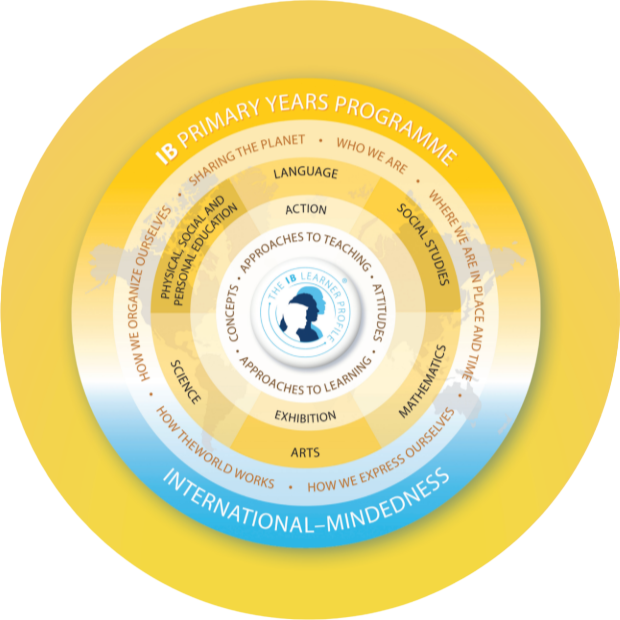
The six transdisciplinary themes provide meaningful contexts that connect learning across subjects:
- Who We Are – exploring identity, relationships, and well-being.
- Where We Are in Place and Time – learning about history, journeys, and connections across generations.
- How We Express Ourselves – discovering creativity, culture, and communication.
- How the World Works – investigating science, technology, and the natural world.
- How We Organize Ourselves – understanding systems, communities, and decision-making.
- Sharing the Planet – reflecting on responsibility, sustainability, and living together.
Through these themes, children develop:
- Knowledge across language, mathematics, science, social studies, arts, and PSPE.
- Conceptual understanding that transfers across subjects and real-life situations.
- Skills in thinking, research, communication, self-management, and social collaboration.
- Learner Profile attributes such as curiosity, empathy, and responsibility.
- Action, where children apply their learning to make a difference in their community and the wider world.
This integrated approach ensures learning is engaging, relevant, challenging, and significant hallmarks of the IB Primary Years Programme